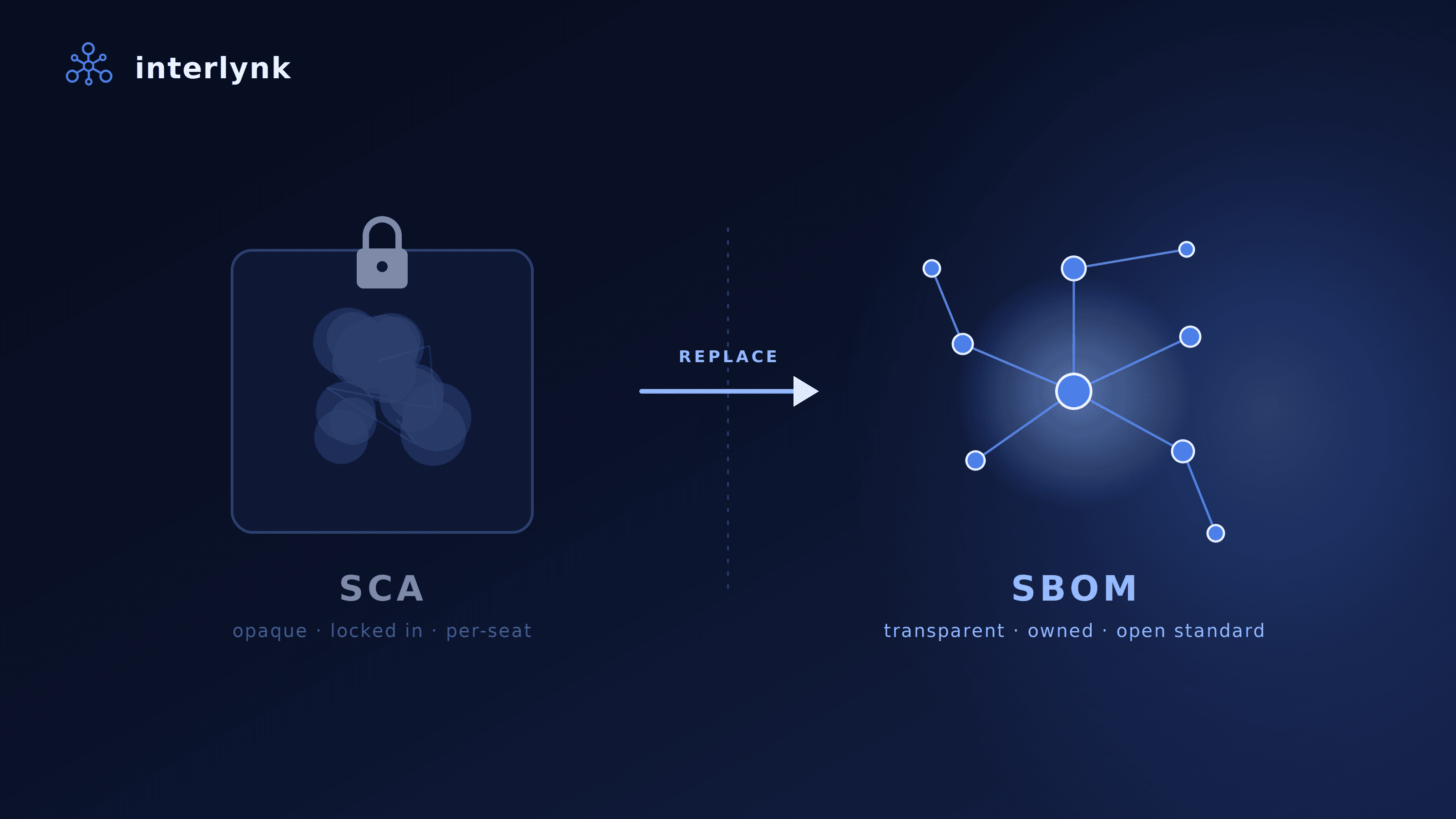
Most teams running Software Composition Analysis are already operating an SBOM pipeline. They just don't keep the output. The tool builds an inventory of their dependencies, matches it against vulnerability data, and locks the result inside a console they rent by the seat. The inventory at the center of all that is a software bill of materials in everything but name.
Once you see SCA that way, migrating to an SBOM-first workflow stops looking like a rip-and-replace project and starts looking like reclaiming an artifact you were already producing. This guide walks through what the two approaches actually do, why an open SBOM workflow can replace a standalone scanner, the conditions that have to be met first, and a migration path you can run without a gap in coverage.
What an SCA tool does, mechanically
It helps to separate what an SCA product does from how it's packaged. Underneath the dashboard, the work is three steps in sequence.
The tool builds a dependency inventory. It walks your lockfiles and manifests, resolves the full transitive tree, and produces a list of components with versions and identifiers such as purl and CPE. This list is, by definition, a software bill of materials. It is simply rendered inside a proprietary interface rather than handed back as a portable file.
The tool then matches that inventory against a vulnerability database and a set of license policies, producing findings.
Finally, it presents those findings through a workflow you license: dashboards, gates, reports, and per-seat access.
The first step is SBOM generation. The second is vulnerability matching. The third is the wrapper. Recognizing that the first two are commodity operations, and the third is what you're paying a premium for, is the foundation of the migration argument.
What an SBOM-first workflow does
An SBOM-first workflow performs the same two mechanical operations. The difference is that it decouples them and keeps the artifact at the center.
You generate a standardized SBOM at build time. The two dominant formats are SPDX, the Linux Foundation standard recognized internationally as ISO/IEC 5962:2021, and CycloneDX, the OWASP flagship standard ratified as ECMA-424. Both are machine-readable, both are open, and both are supported across a large ecosystem of tooling.
You then match that SBOM against vulnerability intelligence on a continuous basis, and you apply triage data to suppress findings that don't apply to your deployment.
The result is a portable, signable file that records exactly what shipped. You can re-scan it weeks later, share it with a customer, or submit it to a regulator. None of those are things you can reliably do with findings trapped in a vendor console.
The real distinction: ownership, not capability
It's worth being precise about where SCA and an SBOM workflow actually differ, because it is not in what they can detect.
A standalone scanner produces findings inside an interface you do not own and cannot take with you. An SBOM workflow produces a standardized artifact you own outright and can reuse anywhere. The vulnerability matching, the license checks, the dependency resolution: those are present in both. What changes is whether you walk away with an asset or a subscription.
Every practical advantage of the SBOM approach follows from that single difference. Portability, reusability across teams, long-term re-scanning, and direct use in compliance all depend on holding the artifact rather than viewing it through someone else's product.
You no longer need the vendor's vulnerability database
For years, the strongest objection to leaving SCA behind was the data. The assumption was that a commercial vendor's vulnerability feed was meaningfully better than anything you could assemble yourself. That advantage has largely disappeared.
OSV.dev, Google's open vulnerability database, provides precise version-level affected ranges across ecosystems, and its scanner reads SPDX and CycloneDX SBOMs directly. Open matchers such as Grype cross-reference the NVD, OSV, and ecosystem-specific advisories, which are the same primary sources commercial tools draw from. OWASP Dependency-Track extends this further: rather than scanning once, it ingests SBOMs into a persistent store and continuously re-evaluates them as new CVEs are published, with EPSS-based prioritization built in.
That continuous re-evaluation is the capability most scanner users underestimate. A point-in-time scan reports what was vulnerable the moment it ran. A monitored SBOM reports what is vulnerable now, because a component that was clean at build time can have a critical vulnerability disclosed against it after release. A pipeline scan triggered only on commit will miss that window entirely; a continuously monitored SBOM will not.
For false positives, VEX (Vulnerability Exploitability eXchange) lets you assert, in a documented and auditable form, that a flagged vulnerability is not reachable or exploitable in your specific context, and have your tooling suppress it on that basis. This is a defensible, reviewable record rather than a setting hidden inside a proprietary console.
For regulated teams, the SBOM is already required
In regulated software, the case for an SBOM-first workflow is not just sound, it is close to inevitable, because the SBOM is already a mandatory deliverable.
Medical device software is the clearest example. Under Section 524B of the FD&C Act, in effect since March 29, 2023, manufacturers of "cyber devices" must include a machine-readable SBOM covering commercial, open-source, and off-the-shelf components in their premarket submissions. The FDA's final premarket cybersecurity guidance, issued in June 2025, makes an inadequate SBOM grounds for a Refuse-to-Accept decision and points to SPDX and CycloneDX as expected formats.
More broadly, CISA's 2025 Minimum Elements for an SBOM, building on the 2021 NTIA baseline, raise expectations with additional fields including component hash, license, tool name, and generation context, all intended to support machine-processable use at scale.
The implication is direct. If you operate in this space, you are already generating an SBOM for compliance no matter which scanner you run. Pointing your vulnerability detection at that same artifact does not add a workflow; it consolidates two. The alternative is to pay a vendor to build a dependency inventory, then rebuild that inventory in a different format for the regulator, with no shared source of truth between the two. That duplication is the gap between operational supply chain security and compliance box-checking, and it is exactly the cost an SBOM-first workflow removes.
Two conditions for a complete replacement
An SBOM-first workflow can fully replace standalone SCA, but only when two conditions are met. They are worth stating plainly, because skipping them is how SBOM programs fail.
You need access to the code or the build. The most accurate SBOMs are generated at build time, from source, where the resolver observes the real transitive tree and the exact versions that ship. Post-hoc scanning of a closed third-party binary is possible but lossy. If you can instrument CI to emit an SBOM on every build, you achieve fidelity that matches or exceeds what an SCA tool reconstructs externally. Where you cannot touch the build, the SBOM approach is genuinely harder, and that should factor into your planning.
You need a coordinated workflow between Development and Compliance. This is the part no tool can supply. Engineering owns generation: SBOMs are produced in CI as a standard build output, comparable to a test report. Security and Compliance own consumption: ingesting SBOMs, monitoring them continuously, attaching VEX, and feeding the regulatory submission. When those two halves are not connected, SBOMs get generated and never examined, which is precisely the failure mode that gave the format its reputation as a checkbox exercise.
Meet both conditions and there is no function a standalone scanner performs that your own pipeline cannot, with a portable artifact in your possession at the end. Miss either one and the right move is to fix the workflow first and keep your existing tooling until you have.
A migration path
The transition does not require a hard cutover. Run the SBOM workflow alongside your existing scanner until it reaches parity, then retire the subscription.
Generate. Emit an SPDX or CycloneDX SBOM on every CI build, from source, and treat it as a first-class build artifact.
Store and monitor. Ingest those SBOMs into a continuous-monitoring platform so they are re-evaluated against OSV, NVD, and advisory feeds as new vulnerabilities are published, rather than only at scan time.
Triage. Adopt VEX for documented, auditable suppression of non-exploitable findings, and use EPSS to prioritize remediation effort where it matters.
Connect compliance. Route the same SBOMs into your regulatory submissions so a single artifact serves both vulnerability management and compliance.
Compare and cut over. Run both systems in parallel for a release or two. Once the SBOM workflow is catching what the scanner caught, while also providing continuous coverage and an artifact you own, retire the standalone tool.
Conclusion
Software Composition Analysis was a sensible product in an era without SBOM standards. That era is behind us. SPDX and CycloneDX are international standards, the vulnerability data is open, the supporting tooling is mature, and in regulated software the SBOM is mandatory regardless of which scanner you use.
Once you are producing a standardized SBOM you own, paying a separate vendor to rebuild that same inventory behind a console is, stated plainly, paying for compliance theater rather than operational security. Given access to the code and a coordinated workflow between Development and Compliance, an SBOM-first pipeline performs everything a standalone SCA tool does, and leaves you holding the artifact when it's finished.
Further reading: SPDX (Linux Foundation, ISO/IEC 5962:2021) · OWASP CycloneDX (ECMA-424) · CISA 2025 Minimum Elements for an SBOM · FDA premarket cybersecurity guidance · OSV.dev · OWASP Dependency-Track